
Paid course
Grid-Connected Bidirectional Single-Phase Inverter
Explanation and comparison of control methods for a grid-connected bidirectional single-phase inverter - current control, power control, Python examples.
Video course waiting list
Interested in a video version?
Join the waiting list. If enough people are interested, I’ll make a video version of this course.
Already bought the written course? You’ll get the video course automatically if I make it.
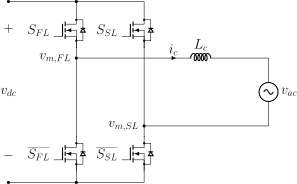
Table of contents
- 1. Introduction
- What the course covers
- Learning outcomes
- Prerequisites
- Notation used throughout
- Control structure in the stationary (abc) and rotating (dq) frames
- 2. The Inverter
- Topology (fast leg and slow leg)
- Simplified model of the inverter
- Control structure
- 3. PWM strategy
- Gate signal derivation (fast-leg duty cycle, slow-leg gate signal)
- Numerical example in Python (sinusoidal reference → S_SL and D_FL waveforms)
- 4. Control in the abc frame
- Current control: PI + feedforward, with numerical example
- Power calculation: the simple method (P = LPF(v_ac · i_c), Q from the power triangle)
- Pure active power control (PFC-style), with numerical example
- Pros and cons of each method
- 5. Control in the dq frame
- Motivation for dq control
- Clarke and Park transformations
- Phase-locked loop (PLL), with numerical example
- Park transform for single-phase: Simple OSG and SOGI
- Power control in dq (P-axis and Q-axis decoupled), with numerical example
- Current control in dq with decoupling terms, with numerical example
- 6. Comparison of control methods
- Control variables, complexity, sensitivity, reactive-power control
- When abc is enough, when dq is preferable
- Appendix
- Hand calculation of the Park transform